
Most businesses don’t think deeply about hosting at the beginning.
You pick something that works.
You launch.
You move on.
But then the business grows.
Traffic increases.
Customers depend on your platform.
Revenue becomes tied to uptime.
And suddenly, hosting is no longer a background decision.
It becomes a strategic one.
At some point, nearly every growing business asks the same question:
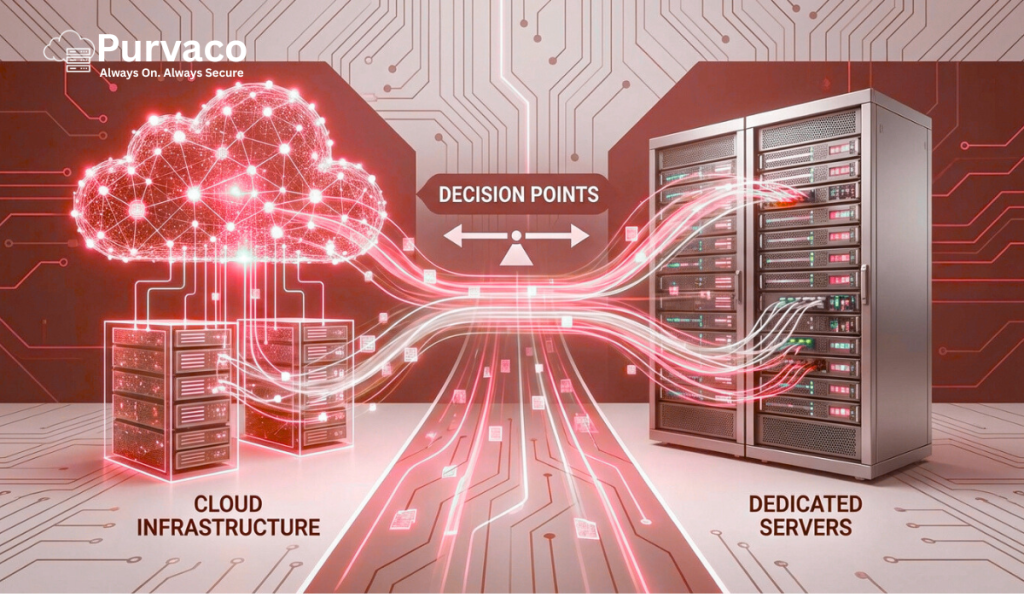
Should we stay on cloud hosting, or move to dedicated servers?
It sounds like a technical question.
In reality, it’s a business question.
Because the answer affects cost, performance, reliability, team workload, and how confidently you can grow.
This article is written for founders, CTOs, and decision-makers who want clarity — not marketing slogans — on cloud hosting vs dedicated servers, and how to choose what’s right for their business.
Why This Comparison Matters More Than Ever
A decade ago, the answer felt obvious.
Cloud hosting was “the future.”
Dedicated servers felt “old-school.”
But reality has matured.
Cloud has evolved — and so have its limitations.
Dedicated servers have improved — and regained relevance.
Today, many businesses are re-evaluating earlier cloud decisions. Not because cloud failed — but because growth changed the requirements.
The best choice is no longer universal.
It’s contextual.
What Cloud Hosting Really Offers
Cloud hosting is built on abstraction.
Instead of managing physical machines, you interact with virtual resources — compute, storage, networking — that can be provisioned on demand.
This abstraction delivers some clear advantages.
The Core Strengths of Cloud Hosting
Cloud hosting shines when flexibility matters.
You can launch quickly.
Scale resources up or down.
Experiment without long-term commitments.
For businesses that face unpredictable demand, cloud hosting offers a sense of freedom.
Cloud hosting works particularly well for:
Early-stage startups
Applications with spiky traffic
Development and testing environments
Short-term projects
Global or distributed user bases
It removes friction in the early phases of growth.
But abstraction comes with trade-offs.
The Hidden Realities of Cloud Hosting
Cloud hosting often feels simple — until it doesn’t.
As systems grow, businesses start encountering issues that aren’t obvious at the beginning.
Performance Variability
Cloud resources are shared at the physical level.
Even with strong isolation, performance can vary due to:
Underlying hardware differences
Noisy neighbors
Virtualization overhead
For many workloads, this doesn’t matter.
For others, it becomes a problem.
Databases, real-time systems, and latency-sensitive applications often struggle with inconsistent performance.
Cost Complexity
Cloud pricing looks friendly at first.
Pay only for what you use.
Scale down when idle.
But as usage grows:
Bandwidth costs increase
Storage accumulates
Monitoring and backups add up
Scaling events spike bills
Many businesses discover that cloud costs grow faster than revenue once traffic stabilizes.
Cloud rewards unpredictability.
It penalizes consistency.
Operational Complexity
Cloud reduces hardware management — but not operational responsibility.
As systems grow, teams must manage:
Scaling rules
Security configurations
Network design
Cost monitoring
Service dependencies
Without strong discipline, cloud environments become complex and fragile.
What Dedicated Servers Really Offer
Dedicated servers take the opposite approach.
Instead of abstraction, they offer ownership — or at least exclusive control — over physical resources.
One server.
One customer.
No sharing.
This simplicity delivers benefits that become more valuable as businesses mature.
The Core Strengths of Dedicated Servers
Dedicated servers excel at predictability.
You know exactly what resources you have.
You know how they behave.
You know what they cost.
This predictability is powerful.
Dedicated servers are ideal for:
High-traffic websites
Database-heavy applications
Revenue-critical platforms
Compliance-driven businesses
Long-running, stable workloads
When performance consistency matters more than instant elasticity, dedicated servers shine.
Performance You Can Rely On
Dedicated servers offer:
Full CPU access
Consistent memory availability
High-performance storage
Stable networking
There are no noisy neighbors.
No virtualization layers to interfere.
Performance under load remains stable — which is critical for applications where slowdowns directly impact users or revenue.
Cost Predictability
Dedicated servers typically come with fixed monthly pricing.
This allows businesses to:
Plan budgets confidently
Forecast costs accurately
Avoid billing surprises
For sustained workloads, dedicated servers often cost less than equivalent cloud setups over time.
Operational Simplicity
Dedicated environments are easier to reason about.
Fewer moving parts.
Clear boundaries.
Straightforward monitoring.
This simplicity reduces operational stress — especially for teams without large DevOps departments.
Where Dedicated Servers Can Fall Short
Dedicated servers are not perfect.
They come with trade-offs that businesses must understand.
Scaling Requires Planning
Dedicated servers don’t scale instantly.
Adding capacity requires:
Provisioning new hardware
Migrating workloads
Planning ahead
This isn’t a problem for predictable growth — but it can feel limiting for sudden spikes.
Upfront Commitment
Dedicated servers usually involve longer commitments.
This can feel restrictive for early-stage businesses still experimenting with direction and scale.
Cloud vs Dedicated: A Practical Comparison
Let’s compare both options across the factors that matter most to businesses.
Performance
Cloud:
Good, but variable under load.
Dedicated:
Consistent and predictable.
If performance stability matters, dedicated servers usually win.
Scalability
Cloud:
Instant elasticity.
Dedicated:
Planned scaling.
If traffic is unpredictable, cloud has the edge.
If traffic is stable, dedicated servers are sufficient and often better.
Cost
Cloud:
Low entry cost, unpredictable long-term spend.
Dedicated:
Higher entry cost, predictable monthly pricing.
For sustained workloads, dedicated servers often become more cost-effective over time.
Security
Cloud:
Strong platform security, but shared responsibility.
Dedicated:
Physical isolation, full control.
Both can be secure — but dedicated servers simplify isolation and compliance.
Operational Overhead
Cloud:
Less hardware management, more configuration complexity.
Dedicated:
More responsibility, but simpler environments.
Teams often find dedicated environments easier to manage at scale.
Why Many Businesses End Up Choosing Hybrid
As businesses mature, many realize the answer isn’t cloud or dedicated.
It’s both.
Hybrid architectures combine:
Dedicated servers for core systems
Cloud resources for bursts, experiments, and global reach
CDNs for traffic distribution
This approach delivers:
Predictability where it matters
Flexibility where it helps
Better cost control
Reduced risk
Hybrid setups are increasingly common for growing and enterprise-level businesses.
Which Option Is Better for Your Business Stage?
The “right” choice often depends on where you are.
Early-Stage Businesses
Cloud hosting is usually better.
Fast setup
Low commitment
Room to experiment
At this stage, flexibility matters more than optimization.
Growing Businesses
This is where the decision becomes nuanced.
If traffic is stabilizing and costs are rising, dedicated servers deserve serious consideration.
If growth is unpredictable, hybrid approaches work well.
Mature Businesses
Dedicated or hybrid setups often make the most sense.
Predictable performance
Stable costs
Operational confidence
At this stage, hosting becomes a foundation — not an experiment.
Common Mistakes Businesses Make in This Decision
Choosing based on hype
Ignoring long-term costs
Overestimating elasticity needs
Underestimating performance requirements
Avoiding planning
The biggest mistake is assuming there is a permanent answer.
The right hosting choice evolves with the business.
How to Decide Without Regret
Before choosing cloud or dedicated hosting, ask:
How predictable is our traffic?
How critical is performance consistency?
How sensitive are we to cost fluctuations?
How much operational complexity can we handle?
What will this look like in two years?
The best decision is not the trendiest one.
It’s the one that supports calm, confident growth.
Conclusion: Growth Changes the Question, Not the Goal
At the beginning, hosting is about getting online.
As you grow, hosting becomes about staying reliable.
Cloud hosting and dedicated servers are not enemies. They’re tools — each suited to different phases of growth.
Cloud excels at exploration.
Dedicated servers excel at stability.
The businesses that scale well are not the ones that pick a side and defend it forever.
They’re the ones that adapt.
They reassess.
They evolve.
They build foundations strong enough to carry the weight of success.
And resilience, in the end, comes not from choosing cloud or dedicated — but from choosing intentionally, with growth in mind.
FAQs
1. Is cloud hosting always better than dedicated servers?
No. Cloud is flexible, but dedicated servers often outperform cloud for stable, high-traffic workloads.
2. When should a business move from cloud to dedicated servers?
When performance consistency matters and cloud costs become unpredictable.
3. Are dedicated servers outdated?
No. They remain highly relevant for performance-critical and enterprise workloads.
4. Can businesses use both cloud and dedicated hosting?
Yes. Hybrid setups are increasingly common and effective.
5. Which option is more secure?
Both can be secure. Dedicated servers simplify isolation, while cloud requires careful configuration.
6. What matters more: flexibility or predictability?
It depends on your business stage. Early growth favors flexibility; maturity favors predictability.