
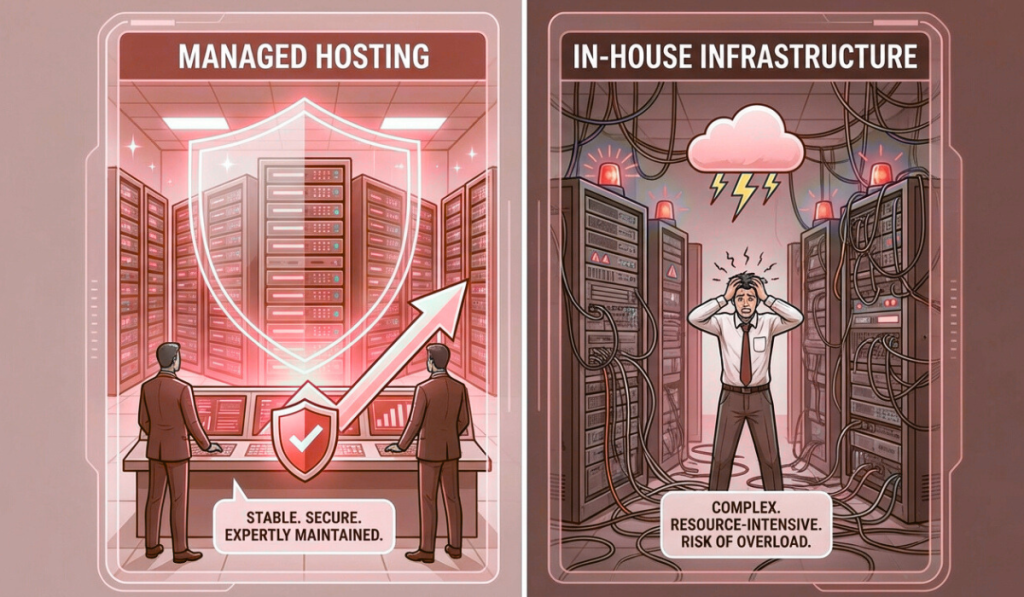
In the early days of a business, infrastructure decisions feel simple.
You set up servers.
Someone on the team manages them.
Things mostly work.
There is a sense of control.
A feeling that “we’ve got this handled.”
But then the business grows.
Traffic increases.
Customers depend on uptime.
Systems become more complex.
Downtime becomes expensive instead of inconvenient.
And slowly, a question starts to surface — not in technical meetings, but in leadership discussions:
Should we continue managing infrastructure in-house, or move to managed hosting?
This question doesn’t come from weakness.
It comes from maturity.
Because at scale, infrastructure is no longer just about servers.
It’s about risk, focus, cost, and resilience.
This article explores managed hosting vs in-house infrastructure from a real business perspective — not theory, not vendor promises, but how these choices actually affect growing companies.
What In-House Infrastructure Really Means
In-house infrastructure sounds straightforward.
You own or rent servers.
Your team sets them up.
Your team monitors them.
Your team fixes issues.
On paper, this feels empowering.
You control everything.
You customize everything.
You depend on no one else.
And for some businesses, especially in early stages, this approach works well.
But as systems grow, in-house infrastructure becomes less about control and more about responsibility.
The Hidden Scope of In-House Infrastructure
Most businesses underestimate what “managing infrastructure” actually includes.
It’s not just keeping servers running.
It’s also:
24/7 monitoring
Incident response
Security patching
Backup verification
Capacity planning
Hardware failures
Performance tuning
Disaster recovery planning
Documentation
On-call rotations
In other words, in-house infrastructure is not a task.
It’s a continuous operation.
And operations don’t pause when your team is busy with product launches, customer meetings, or growth initiatives.
Why Businesses Choose In-House Infrastructure Initially
There are valid reasons many companies start with in-house infrastructure.
Perceived Cost Savings
At first glance, in-house hosting looks cheaper.
No managed service fees.
No external support costs.
Just hardware and hosting expenses.
But this view often ignores the cost of people, time, and risk.
Control and Customization
Some teams want full control.
They want to tune everything.
Experiment freely.
Avoid external dependencies.
For highly specialized workloads or very experienced teams, this can be beneficial.
Early-Stage Simplicity
In the beginning, systems are small.
Traffic is manageable.
Incidents are rare.
One person can “keep an eye on things.”
At this stage, in-house infrastructure often feels sufficient.
The problem is not where businesses start.
It’s where they stay too long.
What Changes as the Business Grows
Growth changes infrastructure dynamics quietly.
More users mean more load.
More data means heavier databases.
More features mean more moving parts.
Suddenly:
Servers need tuning.
Monitoring needs to be proactive.
Security risks increase.
Downtime becomes visible to customers.
The same infrastructure that worked last year now feels fragile.
This is where the cracks begin to show.
The Real Cost of In-House Infrastructure
In-house infrastructure costs are rarely transparent.
They’re distributed across salaries, stress, and opportunity loss.
People Cost
Infrastructure doesn’t manage itself.
Someone must:
Respond to alerts at night
Investigate slowdowns
Apply updates
Fix outages
That “someone” is often a senior engineer — the same person who could be building features or improving the product.
Opportunity Cost
Every hour spent firefighting infrastructure is an hour not spent on growth.
Delayed releases
Slower innovation
Burned-out teams
These costs don’t show up on invoices, but they compound over time.
Risk Cost
In-house teams are rarely staffed for worst-case scenarios.
What happens when:
A key engineer leaves?
Multiple failures occur at once?
A security incident happens at night?
Risk exposure increases silently.
What Managed Hosting Actually Means
Managed hosting is often misunderstood.
It’s not “giving up control.”
It’s not “outsourcing responsibility blindly.”
Managed hosting means partnering with a team whose core job is infrastructure operations.
They handle:
Monitoring
Security
Updates
Backups
Incident response
Optimization
So your internal team doesn’t have to.
This shift changes how businesses operate.
Why Businesses Move to Managed Hosting
Most businesses don’t move to managed hosting because they want less control.
They move because they want less chaos.
Stability Over Heroics
In-house setups often rely on hero engineers.
The person who fixes things at midnight.
The person who knows the system inside out.
Managed hosting replaces heroics with processes.
Systems don’t depend on individuals.
They depend on procedures.
Predictable Operations
With managed hosting:
Issues are detected early
Incidents are handled calmly
Maintenance is planned
Communication is clear
This predictability reduces stress across the organization.
Focus on Core Business
Perhaps the biggest benefit is focus.
Product teams build.
Sales teams sell.
Leadership plans.
Infrastructure stops being a daily concern.
Managed Hosting vs In-House: A Practical Comparison
Let’s compare both approaches where it actually matters.
Reliability
In-house:
Depends heavily on team availability and experience.
Managed hosting:
Designed around uptime, redundancy, and proactive monitoring.
If uptime affects revenue or reputation, managed hosting usually wins.
Security
In-house:
Security is only as strong as the team’s time and expertise.
Managed hosting:
Security is continuous, structured, and monitored.
Security failures rarely come from lack of tools — they come from lack of attention.
Cost
In-house:
Appears cheaper initially, becomes expensive as complexity grows.
Managed hosting:
Higher visible cost, lower hidden cost.
When people, risk, and downtime are factored in, managed hosting is often more economical.
Scalability
In-house:
Scaling requires planning, hiring, and often stress.
Managed hosting:
Scaling is supported by experience and infrastructure readiness.
Growth feels less disruptive.
Team Health
In-house:
On-call stress, firefighting, burnout.
Managed hosting:
Calmer teams, fewer emergencies, better work-life balance.
This matters more than most businesses admit.
When In-House Infrastructure Still Makes Sense
Managed hosting is not the right answer for everyone.
In-house infrastructure can still make sense when:
You have a large, experienced ops team
Infrastructure is your core competency
Workloads are highly specialized
You require full internal control for regulatory reasons
The key is honesty.
If your team truly wants to run infrastructure — and is staffed to do it well — in-house can work.
For most growing businesses, this is not the case.
Why Many Businesses Switch Too Late
The shift to managed hosting often happens after a crisis.
A major outage.
A security incident.
A failed campaign.
At that point, the decision is reactive.
Emergency migrations are stressful.
They increase risk.
They consume leadership attention.
The healthiest transitions happen before things break.
The Middle Ground: Shared Responsibility Models
Some businesses choose a hybrid approach.
Managed hosting for core infrastructure
In-house control over application logic
Clear responsibility boundaries
This model provides balance.
You retain strategic control while reducing operational burden.
What Businesses Gain After Moving to Managed Hosting
Most companies report similar outcomes after the transition:
Fewer incidents
Calmer operations
Clearer planning
Better sleep
The infrastructure fades into the background — where it belongs.
Conclusion: Growth Forces Hard Choices — Calm Is One of Them
In-house infrastructure often starts as a symbol of control.
Managed hosting often starts as a perceived compromise.
But as businesses grow, the meaning shifts.
Control becomes responsibility.
Responsibility becomes risk.
The question is no longer:
“Can we manage this ourselves?”
It becomes:
“Should we?”
Managed hosting is not about surrendering control.
It’s about choosing where your energy matters most.
Growth demands focus.
Resilience demands stability.
And the strongest businesses are not the ones that do everything themselves — but the ones that build foundations strong enough to carry growth without constant strain.
By Purvaco, this perspective comes from seeing businesses at every stage — and watching how the right infrastructure decision changes not just systems, but confidence.
FAQs
1. Is managed hosting better than in-house infrastructure?
For most growing businesses, yes. It reduces risk, stress, and operational overhead.
2. Is managed hosting more expensive?
It may appear so upfront, but often costs less when downtime, staff time, and risk are considered.
3. Does managed hosting mean losing control?
No. You retain strategic control while offloading day-to-day operations.
4. When should a business move away from in-house infrastructure?
When infrastructure issues begin affecting growth, focus, or reliability.
5. Can businesses use a hybrid approach?
Yes. Many businesses combine managed infrastructure with internal oversight.
6. Who benefits most from managed hosting?
SaaS companies, high-traffic websites, enterprises, and any business where uptime matters.

At Purvaco, we help businesses build, host, secure, and scale their digital infrastructure with confidence. As a cloud and hosting company focused on performance, reliability, and business growth, Purvaco delivers enterprise-grade solutions including cloud hosting, VPS hosting, dedicated servers, managed infrastructure, cybersecurity, disaster recovery, and application hosting.
Driven by a customer-first approach and backed by expert support, Purvaco works with startups, SMEs, and enterprises to simplify infrastructure management and accelerate digital transformation. Our mission is to provide secure, scalable, and high-performance hosting environments that keep businesses always connected, always secure, and ready for growth.