
Low Cost Cloud Hosting India – The Complete 2026 Guide to Affordable, Secure & Scalable Cloud Infrastructure

Cloud hosting in India has evolved rapidly over the last decade. What was once considered expensive and complex is now accessible, affordable, and essential for businesses of all sizes. As we move into 2026, low cost cloud hosting in India is no longer about choosing the cheapest plan—it’s about finding the right balance between cost, performance, reliability, and security. This in-depth guide is written for business owners, startups, developers, agencies, and growing websites that want modern cloud infrastructure without overpaying or compromising on quality. Why Low Cost Cloud Hosting in India Is in High Demand India’s digital economy is growing at an unprecedented pace. Businesses are moving online faster than ever—whether it’s e-commerce, SaaS, fintech, education, healthcare, or content platforms. With this growth comes new infrastructure challenges: Websites must load instantly Applications must scale during traffic spikes Downtime is unacceptable Data security is non-negotiable Budgets must remain controlled The Shared Hosting Problem Traditional shared hosting struggles with modern workloads. It suffers from: Resource contention Performance inconsistency Limited scalability Weak isolation and security risks Why Cloud Hosting Became the Default Choice Cloud hosting solves these problems by offering: On-demand resources High availability Better performance isolation Flexible pricing models The result? Businesses are actively searching for low cost cloud hosting in India that delivers enterprise-grade reliability at startup-friendly pricing. What Is Cloud Hosting? Definition of Cloud Hosting Cloud hosting is a hosting model where your website or application runs on a cluster of interconnected servers rather than a single physical machine. Resources are dynamically allocated based on demand. Instead of relying on one server: Workloads are distributed Failures are isolated Scalability is built-in How Cloud Hosting Works Cloud hosting uses virtualization and orchestration technologies to: Pool computing resources (CPU, RAM, storage) Distribute workloads across multiple nodes Automatically scale resources up or down This architecture makes cloud hosting more resilient and flexible than traditional hosting. Why Choose Cloud Hosting in India? Local Data Centers Matter Choosing cloud hosting with Indian data centers provides: Lower latency for Indian users Faster website and app performance Better compliance with regional data expectations Improved reliability for domestic traffic SEO & Performance Benefits Search engines reward fast, reliable websites. Hosting closer to your audience improves: Core Web Vitals Page load speed User engagement Conversion rates Improved User Experience Whether users are browsing products, accessing dashboards, or making payments, cloud hosting ensures: Smooth interactions Minimal delays Higher trust and credibility What Does “Low Cost Cloud Hosting” Really Mean? Cost-Effective vs Cheap Cloud Hosting Low cost cloud hosting does not mean: Overloaded servers Unstable infrastructure Hidden charges Minimal support Instead, it means: Transparent pricing Efficient resource utilization Predictable performance Essential security included Hidden Costs to Watch Out For Some low-priced plans charge extra for: Backups Bandwidth usage Security features Technical support Scaling beyond limits Always evaluate total cost of ownership, not just entry pricing. Resource Overselling Risks Oversold cloud environments lead to: Sudden slowdowns Inconsistent performance Unexpected downtime True low cost cloud hosting balances density, performance, and reliability. Cloud Hosting vs Traditional Hosting Models Feature Shared Hosting VPS Hosting Cloud Hosting Performance Inconsistent Stable Highly Stable Scalability Limited Moderate Instant Availability Single server Single VM Multi-node Security Basic Strong Advanced Pricing Model Fixed Fixed Flexible Best For Beginners Growing sites Modern businesses Cloud hosting clearly stands out for scalability, uptime, and long-term value. Who Should Use Low Cost Cloud Hosting in India? Small & Medium Businesses Cloud hosting provides: Reliable uptime Fast websites Affordable scaling Startups Startups benefit from: Pay-for-what-you-use pricing Easy scaling during growth Infrastructure flexibility Developers & Tech Teams Developers gain: API-driven infrastructure Custom environments Better testing and deployment workflows E-commerce Stores Cloud hosting supports: High traffic sales events Secure transactions Fast checkout experiences Agencies & SaaS Providers Agencies and SaaS platforms need: Multi-tenant reliability Performance isolation Predictable billing Key Features to Look for in Low Cost Cloud Hosting 1. Scalable Resources Instant scaling of: CPU RAM Storage No downtime migrations required. 2. High Availability Architecture Multi-node setups ensure: Fault tolerance Minimal downtime Better disaster recovery 3. SSD / NVMe Storage Fast storage directly impacts: Page speed Database performance Application responsiveness 4. Network Reliability Look for: Redundant networking High bandwidth allocation Low latency routing 5. Control & Management Options include: Web control panels API access Automation support Types of Cloud Hosting Explained Public Cloud Hosting Shared cloud infrastructure Cost-effective Ideal for startups and SMBs Private Cloud Hosting Dedicated cloud resources Higher cost Stronger isolation and compliance Hybrid Cloud Hosting Mix of public and private resources Ideal for complex workloads Low cost cloud hosting in India is usually public cloud-based, optimized for efficiency. Managed vs Unmanaged Cloud Hosting Managed Cloud Hosting Includes: Server setup Monitoring Security updates Technical support Best for: businesses without in-house sysadmins Unmanaged Cloud Hosting You manage: OS Security Updates Performance tuning Best for: developers and experienced teams Cost vs Value Managed cloud hosting may cost more monthly, but it often saves money by: Preventing downtime Reducing security risks Improving operational efficiency Performance Factors That Matter Most in India CPU Performance Dedicated or fairly shared CPU cores prevent throttling during peak usage. Memory Allocation Adequate RAM is critical for: Databases Caching Application frameworks Disk I/O High IOPS ensure: Fast data access Smooth database queries Network Latency Low latency improves: User experience API response times Real-time applications Uptime Guarantees Look for 99.9%+ uptime commitments backed by architecture, not marketing. Security Essentials for Cloud Hosting Network Firewalls Protect against unauthorized access and attacks. DDoS Protection Essential for preventing service outages caused by traffic floods. Data Encryption Both at rest and in transit. Regular Backups Protect against: Accidental deletions Cyber incidents System failures Compliance-Ready Infrastructure Important for businesses handling sensitive data. Cloud Hosting Pricing in India: What Influences Cost? Key Pricing Factors Compute resources (CPU & RAM) Storage type and size Bandwidth usage Management level Security features Typical Pricing Models Monthly fixed plans Usage-based billing Hybrid pricing structures What a Fair Low Cost Plan Includes Transparent pricing Predictable billing Essential security Scalability without penalties Common Mistakes When Choosing
10 Best Managed Cloud Hosting in India (2026 Buyer’s Guide)

India’s digital economy is growing at an unprecedented pace. From startups launching SaaS products to enterprises modernizing legacy applications, cloud infrastructure has become the backbone of business operations. However, managing cloud environments internally requires deep expertise, continuous monitoring, and significant operational overhead. This is where managed cloud hosting in India becomes a strategic advantage. Managed cloud hosting allows businesses to leverage the power of cloud infrastructure while offloading complexity—such as server management, security hardening, updates, monitoring, and performance optimization—to experienced professionals. For Indian businesses, this model is particularly valuable due to data localization requirements, latency sensitivity, cost optimization needs, and the demand for local support. In this in-depth guide, we explore the 10 best managed cloud hosting providers in India, explain what truly matters when choosing a provider, and help you determine which solution aligns best with your business goals. What Is Managed Cloud Hosting? Managed cloud hosting is a service model where the cloud infrastructure (public, private, or hybrid) is actively managed by a hosting provider. Instead of just provisioning virtual machines, the provider takes responsibility for: Server setup and configuration OS and software updates Performance tuning Security management Monitoring and incident response Backups and disaster recovery Technical support This allows businesses to focus on applications, customers, and growth, rather than infrastructure maintenance. Why Managed Cloud Hosting Is Critical for Indian Businesses India presents unique infrastructure and compliance challenges that generic global hosting solutions often fail to address. 1. Data Localization & Compliance Regulations and industry standards increasingly require data to be hosted within Indian borders. Local cloud providers with Indian data centers ensure compliance and reduce legal risk. 2. Low Latency for Indian Users Hosting workloads closer to end users significantly improves application speed, user experience, and SEO performance. 3. Cost Efficiency Managed services reduce the need for in-house DevOps teams, lowering long-term operational costs. 4. Local Support & Faster Resolution India-based support teams understand local network conditions, ISPs, and traffic patterns—resulting in faster troubleshooting. Key Factors to Evaluate When Choosing Managed Cloud Hosting in India Before reviewing the top providers, it’s important to understand the evaluation criteria: Infrastructure reliability & uptime SLAs Level of management (basic vs fully managed) Security capabilities (firewalls, DDoS protection, patching) Scalability and flexibility Support quality and response times Pricing transparency India-specific data center availability 10 Best Managed Cloud Hosting Providers in India 1. Purvaco – Best Overall Managed Cloud Hosting in India Purvaco stands out as a cloud-first, India-optimized managed hosting provider designed for businesses that demand reliability, performance, and expert support without operational complexity. Why Purvaco Leads the Market: Fully managed cloud infrastructure India-based data centers with global connectivity 24/7 proactive monitoring and support Advanced security, including DDoS protection Custom cloud architectures for startups, SMEs, and enterprises Purvaco focuses on hands-on management, not just infrastructure provisioning. This makes it an ideal choice for companies that want predictable performance and peace of mind. Best For:Startups, SaaS platforms, e-commerce businesses, and enterprises looking for a trusted Indian managed cloud partner. 2. Tata Communications Cloud Services Backed by Tata’s global network, this provider offers enterprise-grade cloud solutions with managed services. Strengths: Strong network backbone Enterprise credibility Hybrid cloud options Limitations:Higher cost and less flexibility for startups and small businesses. 3. Sify Technologies Sify provides managed cloud hosting with a focus on large enterprises and government projects. Strengths: Extensive data center presence in India Compliance-driven solutions Limitations:Complex onboarding and enterprise-oriented pricing. 4. Netmagic (NTT) Netmagic is known for managed hosting and cloud solutions for large enterprises. Strengths: Robust managed services Strong security and compliance focus Limitations:Less agile for fast-growing startups. 5. CtrlS Cloud CtrlS operates Tier-4 data centers in India and offers managed cloud hosting. Strengths: High availability infrastructure Strong disaster recovery capabilities Limitations:Limited customization for smaller workloads. 6. ESDS Software Solution ESDS offers managed cloud hosting with a focus on automation and vertical-specific solutions. Strengths: Auto-scalable cloud platform Industry-focused offerings Limitations:Platform lock-in concerns for some users. 7. NxtGen Cloud Technologies NxtGen provides managed cloud hosting with AI-driven operations. Strengths: Innovative infrastructure management Good enterprise support Limitations:Limited transparency in pricing. 8. AWS Managed Service Providers (India Partners) Several Indian partners provide managed services on top of AWS infrastructure. Strengths: Global cloud ecosystem Advanced tooling Limitations:Costs can escalate quickly without careful optimization. 9. Google Cloud Managed Partners (India) Managed service partners for Google Cloud offer advanced analytics and AI capabilities. Strengths: High-performance infrastructure Strong data analytics stack Limitations:Smaller local support footprint compared to Indian-native providers. 10. Azure Managed Service Providers (India) Microsoft Azure MSPs offer managed cloud hosting suitable for enterprises. Strengths: Excellent for Microsoft-centric environments Strong enterprise integration Limitations:Complex pricing structure. Managed Cloud Hosting vs Self-Managed Cloud Aspect Managed Cloud Hosting Self-Managed Cloud Management Provider handles operations In-house team required Security Proactively managed User responsibility Cost Predictable Hidden operational costs Scalability Assisted & optimized Manual planning Focus Business growth Infrastructure maintenance Common Mistakes Businesses Make When Choosing Managed Cloud Hosting Choosing purely on price instead of value Ignoring support quality and SLAs Overlooking data center location Assuming all “managed” services offer the same level of support Not planning for future scalability Why Managed Cloud Hosting Matters for Startups, SMEs & Enterprises Startups Faster go-to-market No DevOps hiring burden Easy scaling during growth phases SMEs Predictable IT costs Improved uptime and security Focus on core operations Enterprises Compliance-ready infrastructure High availability and disaster recovery Reduced operational risk Why Choose Purvaco for Managed Cloud Hosting in India Purvaco is not just another hosting provider—it is a managed infrastructure partner. What Sets Purvaco Apart: India-first infrastructure strategy Proactive monitoring and optimization Transparent pricing models Personalized architecture design Human support, not ticket-only systems Purvaco’s approach ensures that your cloud environment is secure, scalable, and continuously optimized, without burdening your internal teams. Use Cases Powered by Purvaco Managed Cloud High-traffic e-commerce platforms SaaS and subscription-based products Financial and ERP systems Media and content platforms Enterprise internal applications Conclusion: Choosing the Right Managed Cloud Hosting in India Selecting the right managed cloud hosting provider in India is a strategic decision,
10 Best Managed Odoo Cloud Hosting Providers for Growing Businesses (2026 Guide)
Odoo is not just an application. For many businesses, it becomes: The accounting system The inventory brain The CRM The operations backbone The reporting engine Which means one thing: If Odoo slows down, breaks, or becomes unavailable, business slows down too. Yet many organizations underestimate the role hosting plays in Odoo’s success. They treat it like any other web application, deploy it on generic servers, and hope for the best. That works—until it doesn’t. In 2026, with Odoo being used by fast-growing SMBs and enterprises alike, managed Odoo cloud hosting has become the preferred approach. Not because teams can’t host Odoo themselves—but because ERP systems demand predictability, security, and operational maturity. This guide explains what managed Odoo hosting really means and compares 10 of the best managed Odoo cloud hosting providers, starting with a provider built around infrastructure responsibility rather than shortcuts. What Is Managed Odoo Cloud Hosting? Managed Odoo cloud hosting is a service model where the provider takes responsibility for: Server provisioning and optimization Odoo installation and configuration Performance tuning Security hardening Backups and disaster recovery Monitoring and uptime management Updates and maintenance Instead of managing infrastructure internally, businesses focus on using Odoo, not babysitting it. This model is especially valuable for ERP systems, where downtime, data loss, or misconfiguration directly affect finance, operations, and compliance. Why Managed Hosting Matters More for Odoo Than Most Apps Odoo is not a static website. It is: Database-intensive Highly transactional Sensitive to latency and I/O performance Deeply integrated with business processes Unlike CMS platforms, ERP failures are not cosmetic. They block invoicing, halt inventory movement, and delay decision-making. Managed hosting adds value by: Designing infrastructure specifically for Odoo workloads Preventing common performance bottlenecks Ensuring safe updates and upgrades Providing recovery paths during incidents What to Look for in a Managed Odoo Hosting Provider Before comparing providers, it’s important to understand evaluation criteria. Strong managed Odoo hosting includes: Dedicated or guaranteed resources Optimized PostgreSQL configurations Regular, verified backups Security controls and firewall management Clear responsibility boundaries Support teams familiar with Odoo itself—not just servers With that context, let’s review the top providers. 1. Purvaco – Managed Odoo Cloud Hosting Best for: Businesses that want stability, compliance readiness, and infrastructure ownership clarity Purvaco approaches managed Odoo hosting from an infrastructure-first perspective. Instead of treating Odoo as just another app, it is hosted as a mission-critical ERP system. Key strengths: Cloud and dedicated server options optimized for Odoo Performance-tuned databases and application stacks Strong focus on uptime, backups, and recovery Security and firewall rules aligned with compliance needs Clear support ownership during incidents Purvaco is particularly suitable for growing businesses and enterprises that need predictable ERP performance and a hosting partner that understands operational risk, not just deployment. 2. Odoo.sh (Official Odoo Platform) Best for: Odoo-centric teams that want native integration Odoo.sh is the official hosting platform from Odoo itself. Pros: Tight integration with Odoo ecosystem Automated updates and staging environments Simple setup for standard use cases Limitations: Less infrastructure customization Limited control over underlying resources May not suit complex enterprise compliance needs 3. AWS Managed Odoo Hosting (via Partners) Best for: Enterprises already invested in AWS AWS itself does not provide managed Odoo, but many partners do. Strengths: Highly scalable infrastructure Global availability Strong ecosystem Challenges: Requires experienced partners for true management Cost complexity ERP performance tuning depends heavily on implementation quality 4. Azure-Based Managed Odoo Hosting Best for: Microsoft-centric organizations Azure works well for organizations using: Microsoft 365 Active Directory Windows-based systems Azure Odoo hosting is usually delivered through managed service providers who handle deployment, optimization, and security. 5. Google Cloud Managed Odoo Hosting Best for: Cloud-native and analytics-heavy businesses Google Cloud offers strong networking and performance capabilities. Pros: Excellent performance consistency Advanced monitoring tools Cons: Fewer Odoo-specialized providers Requires careful PostgreSQL tuning 6. DigitalOcean Managed Odoo Hosting Providers Best for: Startups and mid-size businesses DigitalOcean-based managed Odoo hosting is popular for: Simpler pricing Developer-friendly tooling However, ERP workloads may outgrow smaller instances quickly, requiring careful scaling strategies. 7. Kamatera Managed Odoo Hosting Best for: Flexible infrastructure needs Kamatera offers customizable cloud servers with managed options. Strengths: Flexible resource allocation Global data centers Management quality varies depending on service tier. 8. Hetzner-Based Managed Odoo Hosting Best for: Cost-conscious European businesses Hetzner is known for: Strong hardware at competitive pricing Managed Odoo hosting on Hetzner typically requires experienced providers to handle: Security hardening Backups ERP-specific optimizations 9. OVHcloud Managed Odoo Hosting Best for: Businesses focused on data sovereignty OVHcloud emphasizes: European data residency Compliance awareness It can be a strong choice when paired with an Odoo-aware managed service provider. 10. Local ERP Hosting Providers (Region-Specific) Best for: Businesses needing local compliance and support Many regional providers offer managed Odoo hosting with: Local data centers Region-specific compliance knowledge Personalized support Quality varies widely, so due diligence is essential. Managed vs Self-Hosted Odoo: A Reality Check Self-hosting Odoo may look cheaper on paper. In practice, it often leads to: Performance issues Missed backups Security gaps Stress during updates Emergency fixes during business hours Managed hosting transfers operational risk to specialists, allowing internal teams to focus on business processes rather than infrastructure firefighting. Compliance and ERP Hosting In 2026, ERP systems are increasingly tied to: Financial audits Data protection regulations Operational controls Managed Odoo hosting providers that understand compliance help by: Enforcing access controls Maintaining audit-ready configurations Documenting changes and incidents This matters far more than raw server specs. Common Mistakes Businesses Make With Odoo Hosting Even today, many businesses: Host Odoo on undersized servers Ignore database optimization Skip backup verification Delay updates until something breaks Managed hosting exists to prevent exactly these problems. How to Choose the Right Managed Odoo Hosting Provider Ask practical questions: Who handles incidents at 2 a.m.? How quickly can we recover data? What happens during upgrades? How are resources guaranteed? The answers reveal maturity. Why Odoo Hosting Is a Growth Decision As businesses grow: Transaction volume increases Users increase Data becomes more critical Odoo hosting that worked early may
10 Cheap Cloud Hosting Providers in India (2026) – What You Save, What You Risk, and What Actually Scales
Cloud hosting changed everything. No upfront hardware.Quick deployment.Pay-as-you-go pricing. For Indian startups and businesses, cloud hosting opened doors that were previously locked behind capital and complexity. But in 2026, cloud hosting is no longer new.And cheap cloud hosting is no longer automatically smart. Most businesses today don’t fail because they chose the wrong technology. They fail because they chose: Unpredictable infrastructure Overcrowded platforms Support that disappears when traffic spikes “Cheap” plans that quietly become expensive This article breaks down the 10 cheap cloud hosting providers in India, starting with Purvaco, and explains—honestly and practically—what you gain and what you risk with each. The goal is not to scare you away from saving money. The goal is to help you save money without sacrificing growth. What “Cheap Cloud Hosting” Actually Means in 2026 Before comparing providers, let’s be clear. Cheap cloud hosting usually means: Lower monthly pricing Shared underlying infrastructure Limited management Entry-level performance guarantees That doesn’t automatically make it bad. But it does mean trade-offs. In 2026, the real cost of cloud hosting is not the invoice. It’s: Downtime during peak hours Performance drops when neighbours spike Support delays when things break Migration pain when you outgrow the plan This is why Purvaco is used as the comparison baseline. Why Purvaco Is the Benchmark (Even in a “Cheap” List) Purvaco Purvaco is not the cheapest cloud hosting provider in India. And that’s exactly why it belongs at the top. Purvaco is designed for: Growing businesses SaaS platforms High-traffic websites Long-term scalability Instead of racing to the lowest price, Purvaco focuses on: Predictable cloud performance Transparent resource allocation India-based infrastructure Business-grade support Clean upgrade paths In other words, Purvaco represents cheap enough cloud hosting without growth penalties. That makes it the right yardstick. Purvaco Cloud Hosting: What You Get Purvaco cloud hosting focuses on control and consistency. What You Gain Dedicated resource allocation (not burst-only promises) SSD / NVMe-backed cloud storage Stable performance during traffic spikes Indian data centers for low latency Clear pricing, no surprise add-ons Support that understands business impact What You Risk Slightly higher monthly cost than ultra-cheap platforms Purvaco Baseline Summary Factor Purvaco Cloud Hosting Price Mid-range Performance Consistent Resource Transparency High India Latency Low Support Business-grade Scaling Risk Low Verdict:Purvaco is built for businesses that want cheap cloud hosting without rebuilding later. 1. Purvaco (Baseline Choice) Purvaco sets the standard for this list. It’s what cheap providers are compared against, not what they try to beat on price. If your business: Generates revenue Handles real traffic Cannot afford downtime Purvaco is often the safer long-term choice. 2. Hostinger Hostinger is extremely popular for cheap cloud hosting in India. What You Gain Very low starting prices Beginner-friendly interface Global brand presence What You Risk Shared CPU contention Performance fluctuations Overseas infrastructure for many plans Hostinger vs Purvaco Factor Hostinger Purvaco Price Lower Higher Performance Stability Medium High CPU Allocation Shared Dedicated India Data Center Limited Yes Business Support Limited Strong Verdict:Good for small sites and experiments, risky for growing businesses. 3. DigitalOcean DigitalOcean is popular among developers for its simplicity. What You Gain Clean UI Predictable base pricing Developer-friendly environment What You Risk Costs rise quickly with traffic Self-managed responsibility Limited hand-holding DigitalOcean vs Purvaco Factor DigitalOcean Purvaco Entry Cost Low Medium Management DIY Assisted Support Limited Business-grade Scaling Ease Technical Simple India Latency Medium Low Verdict:Great for developers, less ideal for non-technical business owners. 4. Vultr Vultr offers cheap cloud instances with Indian locations. What You Gain Competitive pricing Fast provisioning Indian region availability What You Risk Noisy neighbour issues Minimal support DIY security management Vultr vs Purvaco Factor Vultr Purvaco Price Lower Medium Stability Variable High Support Basic Strong Business Risk Medium Low 5. Linode Linode is known for reliability but remains developer-centric. Gain Good uptime Transparent pricing Risk Limited Indian footprint No managed services Comparison Factor Linode Purvaco Ease for Business Medium High Support Community-heavy Direct Growth Readiness Moderate Strong 6. AWS India AWS is powerful, but cheap only at very small scale. What You Gain Global ecosystem Elastic scaling What You Risk Complex billing Expensive data transfer Hard cost predictability AWS vs Purvaco Factor AWS Purvaco Entry Cost Low Medium Cost Predictability Low High Complexity High Low Business Simplicity Low High 7. Google Cloud India Google Cloud focuses on performance and analytics. Gain Fast infrastructure AI and data tools Risk Cost escalation Less pricing clarity Comparison Area Google Cloud Purvaco Cost Control Low High Ease Technical Business-friendly 8. Microsoft Azure India Azure works well for Microsoft-heavy enterprises. Gain Strong enterprise integration Risk Overkill for small businesses Pricing complexity Comparison Area Azure Purvaco Complexity High Low SMB Fit Medium High 9. MilesWeb MilesWeb targets budget-conscious Indian customers. Gain Indian pricing Local sales focus Risk Resource overselling Performance inconsistency Comparison Factor MilesWeb Purvaco Price Lower Medium Performance Inconsistent Stable 10. GoDaddy GoDaddy is known, but rarely loved for cloud hosting. Gain Brand familiarity Risk Expensive renewals Limited performance tuning Comparison Area GoDaddy Purvaco Value for Money Low High Growth Readiness Weak Strong The Real Truth About Cheap Cloud Hosting Cheap cloud hosting is not wrong. Unplanned cheap cloud hosting is. If your website: Is a hobby → cheap cloud is fine Generates revenue → cheap cloud becomes risky Is growing fast → cheap cloud breaks quietly Most businesses don’t leave cheap cloud hosting because of price. They leave because of: Downtime Support gaps Scaling pain Why Businesses Eventually Move to Providers Like Purvaco Because growth demands: Predictability Support Stability Honest limits Purvaco is not the cheapest. It is the least surprising. And in infrastructure, fewer surprises mean fewer crises. Conclusion: Cheap Cloud Hosting Tests You Before It Saves You Every business wants to reduce costs. That’s healthy. But cloud infrastructure behaves differently from tools and software. Mistakes don’t fail loudly at first. They fail quietly—until traffic arrives. The most resilient businesses are not the ones paying the least. They are the ones that choose platforms that survive growth. In 2026, cheap cloud hosting can
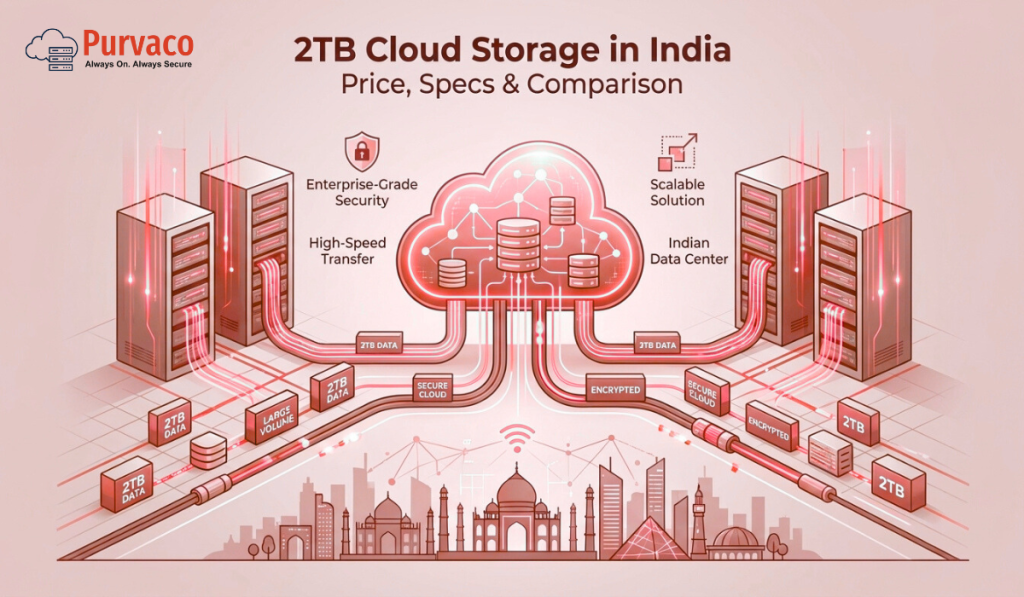
2TB Cloud Storage in India (2026) – Price, Specifications, Rates, and a Real Comparison
There was a time when 2TB sounded excessive. You would hear it and think,“Who needs that much storage?” But in 2026, that thought doesn’t last long. A few years of business data.High-resolution images and videos.Application backups.Accounting files.Logs.User uploads. Suddenly, 2TB doesn’t feel big at all.It feels… responsible. In India, businesses and individuals are generating more data than ever before. From startups storing customer data to professionals archiving years of work, 2TB cloud storage has quietly become the new baseline for serious digital operations. The challenge is not finding 2TB storage. The challenge is understanding: What you actually get for the price How pricing models differ Which specifications matter And why the cheapest option is often the most expensive in the long run This guide breaks down 2TB cloud storage pricing in India, including rates, specifications, comparison factors, and how to choose the right solution without regrets. Why 2TB Cloud Storage Is a Sweet Spot in 2026 Before diving into prices, it’s important to understand why 2TB has become so popular. For most users, 2TB sits in a perfect middle ground: More than enough for daily use Large enough for backups and archives Affordable compared to enterprise-scale storage In India especially, 2TB cloud storage is commonly used for: Business data backups Website and application storage Media archives Accounting and compliance records Team file sharing Disaster recovery copies It’s no longer a luxury tier.It’s a practical working size. What “2TB Cloud Storage” Actually Means This sounds obvious, but it’s one of the most misunderstood points. 2TB cloud storage does not mean the same thing across providers. Some offer: 2TB of object storageOthers offer: 2TB of block storageSome bundle: Storage + bandwidthOthers charge: Separately for everything So when comparing prices, you’re often comparing very different products. Types of 2TB Cloud Storage Available in India 1. Object Storage (Most Common) Object storage is used for: Backups Media files Static content Long-term data retention It’s scalable, durable, and cost-effective. Most “2TB cloud storage” plans in India fall into this category. 2. Block Storage (Performance-Focused) Block storage is typically attached to: Virtual machines Databases Applications It offers better performance but usually costs more. If you’re running workloads, not just storing files, this matters. 3. Cloud Backup Storage Some providers sell 2TB specifically as backup storage, optimized for: Snapshots Versioning Disaster recovery These plans often include automation but may limit direct file access. 2TB Cloud Storage Price in India (2026 Overview) Let’s talk numbers. In 2026, 2TB cloud storage pricing in India typically falls into these ranges: Entry-level / consumer plans: ₹800 – ₹1,500 per month Business-grade object storage: ₹1,500 – ₹3,000 per month Performance or managed storage: ₹3,000 – ₹6,000+ per month Why such a wide range? Because price depends on much more than raw storage size. Key Factors That Affect 2TB Cloud Storage Pricing 1. Storage Type Object storage is cheaper than block storage. If you don’t need high IOPS or low latency, paying for block storage is unnecessary. 2. Data Durability and Replication Some storage is: Single-regionOthers are: Multi-zone or multi-region Higher durability means higher cost, but also better protection. 3. Bandwidth and Egress Charges This is where many users get surprised. Some plans include: Free inbound data Limited outbound data Others charge: Per GB for downloads A cheap 2TB plan with high egress fees can become expensive very quickly. 4. Access Method Are you accessing data via: Web interface? API? Mounted storage? Advanced access methods often cost more. 5. Support and Management Low-cost plans usually mean: Self-service Limited support Business-grade plans include: Monitoring Assistance SLA Support is invisible until you need it. Typical Specifications of a 2TB Cloud Storage Plan While specifications vary, a solid 2TB cloud storage plan in India usually includes: 2TB usable storage High durability (often 99.9%+) Redundant storage across multiple nodes Secure access (encryption at rest and in transit) API or dashboard access Scalable upgrade options Higher-end plans may also include: Automated backups Versioning Snapshot support Monitoring and alerts Comparing 2TB Cloud Storage Options: What Really Matters Instead of comparing brand names, compare capabilities. Here’s how smart buyers evaluate options. Price vs Predictability A low monthly price looks attractive. But ask: Are there hidden charges? What happens if usage increases? Are outbound transfers billed separately? Predictable pricing is often more valuable than cheap pricing. Performance vs Purpose If you’re storing: Archives Backups Media You don’t need ultra-fast storage. If you’re running: Applications Databases Performance matters more than price. Security and Compliance In India, data protection and compliance are becoming stricter. Look for: Encryption Access controls Audit logs Security should not be optional. Scalability 2TB today might become 5TB next year. Choose a provider that allows easy scaling, not painful migrations. Who Should Choose 2TB Cloud Storage? Small Businesses Perfect for: Financial records CRM data Website assets Regular backups 2TB gives room to grow without immediate upgrades. Startups Startups often underestimate storage needs. Logs, user data, and media add up fast. 2TB provides breathing room. Professionals and Creators Designers, video editors, consultants, and developers benefit from: Centralized storage Easy access Backup protection Enterprises (as Secondary Storage) For enterprises, 2TB often serves as: Backup tier Archive storage Disaster recovery copy Why Many People Choose the Wrong 2TB Plan Most mistakes come from short-term thinking. Common issues include: Choosing the cheapest plan without reading limits Ignoring bandwidth costs Underestimating growth Overpaying for performance they don’t need Cloud storage decisions are not about today’s files. They’re about tomorrow’s operations. Managed vs Self-Service 2TB Cloud Storage Self-Service Storage Pros: Lower cost Full control Cons: No guidance You manage security and backups Managed Cloud Storage Pros: Monitoring Security handled Backup policies enforced Cons: Higher monthly cost For businesses, managed storage often saves money by avoiding mistakes. How Indian Businesses Are Using 2TB Cloud Storage in 2026 In practice, we see 2TB used for: Daily automated backups Application data offloading Media hosting Compliance archives Cross-team file sharing It’s rarely just “extra space.” It’s part of a larger reliability strategy. Choosing the Right 2TB Cloud Storage